
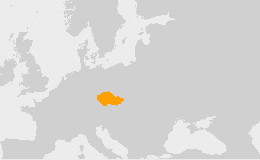
Czech Republic - 2012
Capital: Prague

See general strike, intermittent strike, rotating strike, sit-down strike, sympathy strike, wildcat strike is limited.
29 Forced Labour (1930) 87 Freedom of Association and Protection of the Right to Organise (1948) 98 Right to Organise and Collective Bargaining (1949) 100 Equal Remuneration for Work of Equal Value (1951) 105 Abolition of Forced Labour (1957) 111 Discrimination in Employment and Occupation (1958) 138 Minimum Age for Employment (1973) 182 Worst Forms of Child Labour Convention (1999)
reported violations - 2012
Background
Liek other European countries, the Czech economy was hit by the global economic crisis with an increasing unemployment rate at 9% of the workforce and GDP growth around 1.7% for 2011.
The right-wing coalition government pushed through a series of austerity reforms in the areas of employment, health, pensions, tax and social security, hitting vulnerable social groups hard and weakening workers’ rights and the position of workers’ representatives.
Social dialogue social dialogue Discussion and co-operation between the social partners on matters of common interest, such as economic and social policy. Involves participation by the state where tripartism is practice. has been formal with the government very reluctant to engage in consultation and not respecting social partners social partners Unions and employers or their representative organisations. ’ positions. A day of protest was held in Prague on 21 May, with 50,000 people taking to the streets and further protest activities were held on 17 November, the anniversary of the Velvet Revolution.
29 Forced Labour (1930) 87 Freedom of Association and Protection of the Right to Organise (1948) 98 Right to Organise and Collective Bargaining (1949) 100 Equal Remuneration for Work of Equal Value (1951) 105 Abolition of Forced Labour (1957) 111 Discrimination in Employment and Occupation (1958) 138 Minimum Age for Employment (1973) 182 Worst Forms of Child Labour Convention (1999)
Capital: Prague

reported violations- 2012
Trade union rights in law
Although basic trade union rights are secured, they were set back in 2008 when the Constitutional Court repealed several provisions of the 2007 Labour Code. The right of everyone to associate freely with others to protect economic and social interests is guaranteed in the Constitution. The 2009 anti-discrimination law provides for equal treatment with regard to trade union membership and activities, but does not sufficiently protect workers against anti-union discrimination
anti-union discrimination
Any practice that disadvantages a worker or a group of workers on grounds of their past, current or prospective trade union membership, their legitimate trade union activities, or their use of trade union services. Can constitute dismissal, transfer, demotion, harassment and the like.
See Guide to the ITUC international trade union rights framework
.
Furthermore, while the law recognises the right to collective bargaining
collective bargaining
The process of negotiating mutually acceptable terms and conditions of employment as well as regulating industrial relations between one or more workers’ representatives, trade unions, or trade union centres on the one hand and an employer, a group of employers or one or more employers’ organisations on the other.
See collective bargaining agreement
, there is little scope for negotiations on pay in the public sector. Finally, the right to strike
strike
The most common form of industrial action, a strike is a concerted stoppage of work by employees for a limited period of time. Can assume a wide variety of forms.
See general strike, intermittent strike, rotating strike, sit-down strike, sympathy strike, wildcat strike
, in relation to collective bargaining
collective bargaining
The process of negotiating mutually acceptable terms and conditions of employment as well as regulating industrial relations between one or more workers’ representatives, trade unions, or trade union centres on the one hand and an employer, a group of employers or one or more employers’ organisations on the other.
See collective bargaining agreement
, is coupled with a number of restrictions. To call a strike
strike
The most common form of industrial action, a strike is a concerted stoppage of work by employees for a limited period of time. Can assume a wide variety of forms.
See general strike, intermittent strike, rotating strike, sit-down strike, sympathy strike, wildcat strike
, both a two-thirds majority of the votes cast in a ballot and the participation of one half of total number of employees in the voting procedure is needed. Furthermore, these strikes are only possible after all mediation
mediation
A process halfway between conciliation and arbitration, in mediation a neutral third party assists the disputing parties in reaching a settlement to an industrial dispute by suggesting possible, non-binding solutions.
See arbitration, conciliation
and arbitration
arbitration
A means of resolving disputes outside the courts through the involvement of a neutral third party, which can either be a single arbitrator or an arbitration board. In non-binding arbitration, the disputing parties are free to reject the third party’s recommendation, whilst in binding arbitration they are bound by its decision. Compulsory arbitration denotes the process where arbitration is not voluntarily entered into by the parties, but is prescribed by law or decided by the authorities.
See conciliation, mediation
procedures have been exhausted, which lasts at least 30 days. The list of “essential services
essential services
Services the interruption of which would endanger the life, personal safety or health of the whole or part of the population. Can include the hospital sector, electricity and water supply services, and air traffic control. Strikes can be restricted or even prohibited in essential services.
See Guide to the ITUC international trade union rights framework
” exceeds the ILO
International Labour Organization
A tripartite United Nations (UN) agency established in 1919 to promote working and living conditions. The main international body charged with developing and overseeing international labour standards.
See tripartism, ITUC Guide to international trade union rights
definition. Legal framework for other types of strike
strike
The most common form of industrial action, a strike is a concerted stoppage of work by employees for a limited period of time. Can assume a wide variety of forms.
See general strike, intermittent strike, rotating strike, sit-down strike, sympathy strike, wildcat strike
is still lacking despite relevant constitutional provisions and decisions of the Highest Court of the Czech Republic.
Freedom of association / Right to organize
Principles
Freedom of association :
- >The right to freedom of association is enshrined in the Constitution.
- >The right to freedom of association is regulated by a Labour Code.
Anti-Union discrimination:
- >The law prohibits anti-union discrimination, but does not provide adequate means of protection against it.
Although the anti-discrimination law adopted in 2009 provides for equal treatment with regard to trade union membership or participation in trade union activities, it does not sufficiently protect workers against anti-union discrimination.
Restrictions
Categories of workers prohibited or limited in law from forming or joining a union, or from holding a union office:
- >Armed forces
- >Other civil servants and public employees
- Trade union members cannot be employed in the intelligence services.
Right to collective bargaining
Principles
Right to collective bargaining:
- >The right to collective bargaining is recognised by law.
Right to strike
Principles
Right to strike:
- >The right to strike is enshrined in the Constitution.
- >The right to strike is recognised in the Labour Law.
Restrictions
Legal barriers to lawful strike actions:
- >Excessive representativity or minimum number of members required to hold a lawful strike
- The Act on Collective Bargaining establishes a majority requirement of two-thirds of the votes cast by the workers (subject to a quorum requirement of 50% of the workers concerned by the agreement) before a strike can take place.
- >Excessively long prior notice / cooling-off period
- The time that must elapse before mediation attempts are deemed to have failed and strike action can be taken is 30 days. A strike must be announced three days in advance.
- >Compulsory recourse to arbitration, or to long and complex conciliation and mediation procedures prior to strike actions
- A strike can only be called in the event of disputes over the conclusion of a collective agreement, and is only possible after all mediation and arbitration procedures have been exhausted.
Limitations or ban on strikes in certain sectors:
- >Discretionary determination or excessively long list of "essential services" in which the right to strike is prohibited or severely restricted
- The list of essential services includes the nuclear energy sector as well as the oil and natural gas sector.
29 Forced Labour (1930) 87 Freedom of Association and Protection of the Right to Organise (1948) 98 Right to Organise and Collective Bargaining (1949) 100 Equal Remuneration for Work of Equal Value (1951) 105 Abolition of Forced Labour (1957) 111 Discrimination in Employment and Occupation (1958) 138 Minimum Age for Employment (1973) 182 Worst Forms of Child Labour Convention (1999)
Capital: Prague

reported violations - 2012
In practice
The implementation of a raft of austerity social reforms by the country’s right-wing coalition government has created a harsh environment for trades unions. Indeed the lack of consultation and provision of information during the government’s reform process has been indicative.
CMKOS report regular difficulties in the areas of collective bargaining
collective bargaining
The process of negotiating mutually acceptable terms and conditions of employment as well as regulating industrial relations between one or more workers’ representatives, trade unions, or trade union centres on the one hand and an employer, a group of employers or one or more employers’ organisations on the other.
See collective bargaining agreement
, the right to information and consultation, the freedom to organise and in discrimination against trade union activists. The government’s programme is having a damaging cumulative effect on both workers’ and unions’ rights.
Amendments to the Labour Code which take effect from the beginning of 2012 have already impacted on the collective bargaining
collective bargaining
The process of negotiating mutually acceptable terms and conditions of employment as well as regulating industrial relations between one or more workers’ representatives, trade unions, or trade union centres on the one hand and an employer, a group of employers or one or more employers’ organisations on the other.
See collective bargaining agreement
system as the government seeks to shift employment contracts as a matter for relations between the employer and the individual worker. With the introduction of a minimum membership threshold, employees in small enterprises could lose union rights. Other amendments chip away at unions’ role, including ending the need for employers to consult with unions on matters relating to individuals, as well as ending the requirement of mutual agreement on some workplace issues.
CMKOS believes there was a political agenda behind moves by the finance ministry to stop a strike
strike
The most common form of industrial action, a strike is a concerted stoppage of work by employees for a limited period of time. Can assume a wide variety of forms.
See general strike, intermittent strike, rotating strike, sit-down strike, sympathy strike, wildcat strike
in the transport sector in June; a belief that was vindicated by the courts when CMKOS won an appeal.
The opt-out from the EU’s charter of fundamental rights also remains an area of considerable concern.
29 Forced Labour (1930) 87 Freedom of Association and Protection of the Right to Organise (1948) 98 Right to Organise and Collective Bargaining (1949) 100 Equal Remuneration for Work of Equal Value (1951) 105 Abolition of Forced Labour (1957) 111 Discrimination in Employment and Occupation (1958) 138 Minimum Age for Employment (1973) 182 Worst Forms of Child Labour Convention (1999)
Capital: Prague

reported violations - 2012
Violations
Following the establishment of a local trade union organisation of OS KOVO (Czech Metalworkers’ Union), the management of a globally-known company in Brno started to mount pressure on the trade union committee members, as well as on other workers, inviting them to withdraw their membership of the union or not join it at all. The management established a works council works council 1. A body elected to represent the interests of workers within a workplace through communication and consultation with the employer e.g. concerning working conditions and health and safety issues. 2. A joint council composed of representatives of both workers and the employer for workplace-level discussions on matters of common interest. composed of employees close to management and downgraded the contract of the trade union organisation’s chairman (despite having a university degree he was transferred to manual work). Thereafter, the management introduced administrative steps with a view to dissolving the trade union organisation and refused entry to the premises of a representative of a higher trade union body who had been invited to participate in a public meeting of members.
OS KOVO had to intervene to remedy the situation. The name of the company involved has been kept anonymous at the request of the union.
In a very worrying development, the abuse of several hundred migrant workers in the Czech state forest sector was widely reported in 2011. Workers from Vietnam, Slovakia, Romania and Ukraine were hired by sub-contractors in 2009 to work in the state forests but were left unpaid over a period of months.
The Czech State Forestry enterprise (Lesy CR) had subcontracted work to two Prague based companies Affumicata a.s. and Wood Servis Praha s.r.o. In the case of the Vietnamese workers, it is thought that they were tricked into signing educational rather than employment contracts. Lesy CR said that they could were not responsible for the actions of subcontractors, whilst the parent body of Lesy CR, the agriculture ministry stated that it could not be held responsible for employment matters.
After considerable delay, a foreign company (name withheld at the request of the union) communicated the name of the person authorised to represent the company in labour relations. Thereupon, the branch of OS STAVBA (Czech Building Workers Union) submitted a draft collective agreement and nominated its negotiating team. It included an outside expert (officer of the union), whose participation the employer opposed. The employer provided information exclusively to the chairman of the trade union organisation and was prepared to negotiate directly only with him. This was not in accordance with the relevant provisions of the labour code, according to which information has to be provided to the statutory body of the union, which is the company trade union committee. These provisions also clearly define groups of persons to be present at the bargaining table.
At the same time, the employer announced his decision to withdraw from the existing collective agreement. Several other provisions of the labour code were violated by the employer, including submitting draft individual contracts to employees although the trade union was negotiating collectively.
See collective bargaining agreement
, as well as of workers’ rights (unlawful cuts in wages, bullying, pressure to terminate contracts of employment).
29 Forced Labour (1930) 87 Freedom of Association and Protection of the Right to Organise (1948) 98 Right to Organise and Collective Bargaining (1949) 100 Equal Remuneration for Work of Equal Value (1951) 105 Abolition of Forced Labour (1957) 111 Discrimination in Employment and Occupation (1958) 138 Minimum Age for Employment (1973) 182 Worst Forms of Child Labour Convention (1999)
Capital: Prague
