
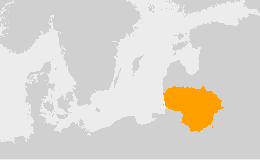
Lithuania - 2012
Capital: Vilnius

29 Forced Labour (1930) 87 Freedom of Association and Protection of the Right to Organise (1948) 98 Right to Organise and Collective Bargaining (1949) 100 Equal Remuneration for Work of Equal Value (1951) 105 Abolition of Forced Labour (1957) 111 Discrimination in Employment and Occupation (1958) 138 Minimum Age for Employment (1973) 182 Worst Forms of Child Labour Convention (1999)
reported violations - 2012
Background
29 Forced Labour (1930) 87 Freedom of Association and Protection of the Right to Organise (1948) 98 Right to Organise and Collective Bargaining (1949) 100 Equal Remuneration for Work of Equal Value (1951) 105 Abolition of Forced Labour (1957) 111 Discrimination in Employment and Occupation (1958) 138 Minimum Age for Employment (1973) 182 Worst Forms of Child Labour Convention (1999)
Capital: Vilnius

reported violations- 2012
Trade union rights in law
Despite recent amendments to the Labour Code, a number of restrictions to trade union rights still apply. The law recognises the right to form and join trade unions, but at least 20 members or one-tenth of the total workforce is required to create a union. Workers who are dismissed cannot keep their trade union membership.
The right to collective bargaining
collective bargaining
The process of negotiating mutually acceptable terms and conditions of employment as well as regulating industrial relations between one or more workers’ representatives, trade unions, or trade union centres on the one hand and an employer, a group of employers or one or more employers’ organisations on the other.
See collective bargaining agreement
is secured in both the private and the public sector, except for certain government employees.
The right to strike
strike
The most common form of industrial action, a strike is a concerted stoppage of work by employees for a limited period of time. Can assume a wide variety of forms.
See general strike, intermittent strike, rotating strike, sit-down strike, sympathy strike, wildcat strike
is rather limited: strikes are only possible if all dispute resolution procedures have been exhausted and can only be called in connection with collective disputes. Solidarity strikes and sympathy strikes are thus not covered. Furthermore, employers have the right to replace striking workers in certain sectors, when minimum services are not provided, including public transport and waste disposal. The authorities can decide on the minimum service
minimum service
The operations needed in a public or private establishment during a strike, normally to avoid compromising the life or basic needs of the population or causing irreversible damages.
See Guide to the ITUC international trade union rights framework
to be established during a strike
strike
The most common form of industrial action, a strike is a concerted stoppage of work by employees for a limited period of time. Can assume a wide variety of forms.
See general strike, intermittent strike, rotating strike, sit-down strike, sympathy strike, wildcat strike
if the parties fail to reach an agreement.
Freedom of association / Right to organize
Principles
Freedom of association :
- >The right to freedom of association is enshrined in the Constitution.
- >The right to freedom of association is regulated by a Labour Code.
- >The right to freedom of association is regulated by law.
Anti-Union discrimination:
- >The law prohibits anti-union discrimination.
Restrictions
Legal barriers to the establishment of organizations:
- >Excessive representativity or minimum number of members required for the establishment of a union
- A company-level trade union must comprise either 30 members or one-fifth of the total workforce (and never have less than three members).
Categories of workers prohibited or limited in law from forming or joining a union, or from holding a union office:
- >Armed forces
- >Others categories
- Workers who are dismissed cannot keep their trade union membership.
Right to collective bargaining
Principles
Right to collective bargaining:
- >The right to collective bargaining is recognised by law.
Restrictions
Limitations or ban on collective bargaining in certain sectors:
- >Other civil servants and public employees
- The Law on Collective Agreements provides for collective bargaining for all employees except government employees involved in law enforcement or security-related work.
Right to strike
Principles
Right to strike:
- >The right to strike is enshrined in the Constitution.
- >The right to strike is recognised in the Labour Law.
Restrictions
Legal barriers to lawful strike actions:
- >Obligation to observe an excessive quorum or to obtain an excessive majority in a ballot to call a strike
- A strike may be called if approved in a secret ballot by at least half of the employees where the strike concerns the whole enterprise or, where the strike only concerns a particular structural unit, by half of those employed in the said unit. A vote is not required for "token" strikes lasting two hours or less.
- >Compulsory recourse to arbitration, or to long and complex conciliation and mediation procedures prior to strike actions
- Strikes can only be called if the collective dispute has not been settled by negotiations, conciliation, mediation, or, if agreed to by the parties, by third party arbitration, or again if the settlement has not been implemented. No additional demands to those addressed during the conciliation or mediation procedure can be put forward during the strike.
Ban or limitations on certain types of strike actions:
- >Restrictions with respect to the objective of a strike (e.g. industrial disputes, economic and social issues, political, sympathy and solidarity reasons)
- Solidarity strikes are not allowed.
- >Restrictions with respect to the level or scope of a strike (e.g. (enterprise, industry and/or sector, regional and/or territorial, national)
- Strikes at the regional, sectoral and national level are not regulated, which means that lawful strikes can only be held at the company level.
Provisions undermining the recourse to strike actions or their effectiveness:
- >Possibility to replace workers during lawful strike actions
- In the event of a strike, the employer is prohibited from employing other persons to perform the work of the striking employees, except for certain sectors including railway and public transport, health care and pharmaceutical institutions, and waste disposal.
Limitations or ban on strikes in certain sectors:
- >Undue restrictions for "public servants"
- Civil servants in the Ministry of Internal Affairs are not allowed to strike, nor is this right granted to civil servants holding head of department positions in an institution or an agency, or other senior positions.
- >Absence of compensatory guarantees for categories of workers deprived of the right to strike
- Strikes are prohibited in first aid medical services, and the demands put forward by the workers concerned are settled by the Government upon consultation with the parties to the collective labour dispute.
- >Unreasonable or discretionary (i.e. without negotiation with social partners or absence of an independent authority in the event of disagreement) determination of the extent of the "minimum service" to be guaranteed during strikes in public services
- The minimum service shall be determined by the parties to a collective dispute within three days of the day on which the trade union notifies the employer about the strike. However, if no agreement is reached by the parties, the decision is to be made by the authorities.
29 Forced Labour (1930) 87 Freedom of Association and Protection of the Right to Organise (1948) 98 Right to Organise and Collective Bargaining (1949) 100 Equal Remuneration for Work of Equal Value (1951) 105 Abolition of Forced Labour (1957) 111 Discrimination in Employment and Occupation (1958) 138 Minimum Age for Employment (1973) 182 Worst Forms of Child Labour Convention (1999)
Capital: Vilnius

reported violations - 2012
29 Forced Labour (1930) 87 Freedom of Association and Protection of the Right to Organise (1948) 98 Right to Organise and Collective Bargaining (1949) 100 Equal Remuneration for Work of Equal Value (1951) 105 Abolition of Forced Labour (1957) 111 Discrimination in Employment and Occupation (1958) 138 Minimum Age for Employment (1973) 182 Worst Forms of Child Labour Convention (1999)
Capital: Vilnius

reported violations - 2012
Violations
See collective bargaining agreement
and demonstrates why the density of collective agreements in the country is so low.
On 10 June members of the Lithuanian Trade Union of Food Producers (LPMS) voted in favour of strike
strike
The most common form of industrial action, a strike is a concerted stoppage of work by employees for a limited period of time. Can assume a wide variety of forms.
See general strike, intermittent strike, rotating strike, sit-down strike, sympathy strike, wildcat strike
action at the Carlsberg brewery in Lithuania in support of their demand for a decent company-level collective agreement. Management sought to stop the strike
strike
The most common form of industrial action, a strike is a concerted stoppage of work by employees for a limited period of time. Can assume a wide variety of forms.
See general strike, intermittent strike, rotating strike, sit-down strike, sympathy strike, wildcat strike
taking place and took legal action to have it declared illegal. Ten days later the Klaipeda district court suspended the start of the planned strike
strike
The most common form of industrial action, a strike is a concerted stoppage of work by employees for a limited period of time. Can assume a wide variety of forms.
See general strike, intermittent strike, rotating strike, sit-down strike, sympathy strike, wildcat strike
for 30 days on the grounds that the production of beer was recognised as ’vitally essential’ in Lithuania. On 5 July the Klaipeda city district court ruled that the strike
strike
The most common form of industrial action, a strike is a concerted stoppage of work by employees for a limited period of time. Can assume a wide variety of forms.
See general strike, intermittent strike, rotating strike, sit-down strike, sympathy strike, wildcat strike
was legal. The management of Carlsberg Lithuania then appealed against this decision and in turn on 5 August the Klaipeda regional court annulled the decision of the lower court, ruling that the brewery strike
strike
The most common form of industrial action, a strike is a concerted stoppage of work by employees for a limited period of time. Can assume a wide variety of forms.
See general strike, intermittent strike, rotating strike, sit-down strike, sympathy strike, wildcat strike
announced in June was indeed illegal. The LPMS has appealed to a higher court in an attempt to get the verdict overturned, and has also submitted a complaint to the ILO
International Labour Organization
A tripartite United Nations (UN) agency established in 1919 to promote working and living conditions. The main international body charged with developing and overseeing international labour standards.
See tripartism, ITUC Guide to international trade union rights
as the suspension of the right to strike
strike
The most common form of industrial action, a strike is a concerted stoppage of work by employees for a limited period of time. Can assume a wide variety of forms.
See general strike, intermittent strike, rotating strike, sit-down strike, sympathy strike, wildcat strike
for such a long period contravenes ILO
International Labour Organization
A tripartite United Nations (UN) agency established in 1919 to promote working and living conditions. The main international body charged with developing and overseeing international labour standards.
See tripartism, ITUC Guide to international trade union rights
norms. The case is also important as it involves a private manufacturer.
In the meantime, Carlsberg Lithuania has sought to put pressure on union leaders and activists at its plant, including dismissing nine activists and re-engaging them on poorer, temporary contracts.
29 Forced Labour (1930) 87 Freedom of Association and Protection of the Right to Organise (1948) 98 Right to Organise and Collective Bargaining (1949) 100 Equal Remuneration for Work of Equal Value (1951) 105 Abolition of Forced Labour (1957) 111 Discrimination in Employment and Occupation (1958) 138 Minimum Age for Employment (1973) 182 Worst Forms of Child Labour Convention (1999)
Capital: Vilnius
