
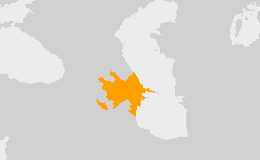
Documented violations - actual number of cases may be higher
Population:
Capital: Baku
Capital: Baku

While the labour laws protect trade union rights, union activity in multinational companies like McDonalds is difficult and often reprimanded.
ILO Core Conventions Ratified:
29 Forced Labour (1930) 87 Freedom of Association and Protection of the Right to Organise (1948) 98 Right to Organise and Collective Bargaining (1949) 100 Equal Remuneration for Work of Equal Value (1951) 105 Abolition of Forced Labour (1957) 111 Discrimination in Employment and Occupation (1958) 138 Minimum Age for Employment (1973) 182 Worst Forms of Child Labour Convention (1999)
reported violations - 2011
Background
On 7 November parliamentary elections were held with President Aliyev’s New Azerbaijan Party (NAP) winning 73 out of 125 seats. Outside observers reported that the elections were marred. A tripartite General Agreement was also signed for the first time since 1994.
ILO Core Conventions Ratified:
29 Forced Labour (1930) 87 Freedom of Association and Protection of the Right to Organise (1948) 98 Right to Organise and Collective Bargaining (1949) 100 Equal Remuneration for Work of Equal Value (1951) 105 Abolition of Forced Labour (1957) 111 Discrimination in Employment and Occupation (1958) 138 Minimum Age for Employment (1973) 182 Worst Forms of Child Labour Convention (1999)
Population:
Capital: Baku
Capital: Baku

reported violations- 2011
Documented violations - actual number of cases may be higher
Trade union rights in law
Trade union rights are adequately protected in the law. Unions are recognised as social partners
social partners
Unions and employers or their representative organisations.
at all levels, including when adopting social and labour laws and regulations. Freedom of association
freedom of association
The right to form and join the trade union of one’s choosing as well as the right of unions to operate freely and carry out their activities without undue interference.
See Guide to the ITUC international trade union rights framework is secured, and the law prohibits anti-union discrimination anti-union discrimination Any practice that disadvantages a worker or a group of workers on grounds of their past, current or prospective trade union membership, their legitimate trade union activities, or their use of trade union services. Can constitute dismissal, transfer, demotion, harassment and the like.
See Guide to the ITUC international trade union rights framework
. Employers can also in general not dismiss employees without the written consent of the trade union within the enterprise. The right to collective bargaining collective bargaining The process of negotiating mutually acceptable terms and conditions of employment as well as regulating industrial relations between one or more workers’ representatives, trade unions, or trade union centres on the one hand and an employer, a group of employers or one or more employers’ organisations on the other.
See collective bargaining agreement
and the right to strike strike The most common form of industrial action, a strike is a concerted stoppage of work by employees for a limited period of time. Can assume a wide variety of forms.
See general strike, intermittent strike, rotating strike, sit-down strike, sympathy strike, wildcat strike are guaranteed. Unions may not carry out purely political strikes, but are allowed to protest against the state’s socioeconomic policies. Finally, workers in essential services essential services Services the interruption of which would endanger the life, personal safety or health of the whole or part of the population. Can include the hospital sector, electricity and water supply services, and air traffic control. Strikes can be restricted or even prohibited in essential services.
See Guide to the ITUC international trade union rights framework
as well as employees of legislative authorities, relevant executive authorities, courts and law enforcement authorities may not go on strike strike The most common form of industrial action, a strike is a concerted stoppage of work by employees for a limited period of time. Can assume a wide variety of forms.
See general strike, intermittent strike, rotating strike, sit-down strike, sympathy strike, wildcat strike .
See Guide to the ITUC international trade union rights framework is secured, and the law prohibits anti-union discrimination anti-union discrimination Any practice that disadvantages a worker or a group of workers on grounds of their past, current or prospective trade union membership, their legitimate trade union activities, or their use of trade union services. Can constitute dismissal, transfer, demotion, harassment and the like.
See Guide to the ITUC international trade union rights framework
. Employers can also in general not dismiss employees without the written consent of the trade union within the enterprise. The right to collective bargaining collective bargaining The process of negotiating mutually acceptable terms and conditions of employment as well as regulating industrial relations between one or more workers’ representatives, trade unions, or trade union centres on the one hand and an employer, a group of employers or one or more employers’ organisations on the other.
See collective bargaining agreement
and the right to strike strike The most common form of industrial action, a strike is a concerted stoppage of work by employees for a limited period of time. Can assume a wide variety of forms.
See general strike, intermittent strike, rotating strike, sit-down strike, sympathy strike, wildcat strike are guaranteed. Unions may not carry out purely political strikes, but are allowed to protest against the state’s socioeconomic policies. Finally, workers in essential services essential services Services the interruption of which would endanger the life, personal safety or health of the whole or part of the population. Can include the hospital sector, electricity and water supply services, and air traffic control. Strikes can be restricted or even prohibited in essential services.
See Guide to the ITUC international trade union rights framework
as well as employees of legislative authorities, relevant executive authorities, courts and law enforcement authorities may not go on strike strike The most common form of industrial action, a strike is a concerted stoppage of work by employees for a limited period of time. Can assume a wide variety of forms.
See general strike, intermittent strike, rotating strike, sit-down strike, sympathy strike, wildcat strike .
Freedom of association / Right to organize
Principles
Freedom of association :
- >The right to freedom of association is enshrined in the Constitution.
- >The right to freedom of association is regulated by a Labour Code.
Anti-Union discrimination:
- >The law prohibits anti-union discrimination.
Employers cannot dismiss employees without the written consent of the trade union within the enterprise.
Right to collective bargaining
Principles
Right to strike
Principles
Right to strike:
- >The right to strike is enshrined in the Constitution.
- >The right to strike is recognised in the Labour Law.
Restrictions
Limitations or ban on strikes in certain sectors:
- >Undue restrictions for "public servants"
- Employees of legislative authorities, relevant executive authorities, courts and law enforcement authorities may not go on strike.
ILO Core Conventions Ratified:
29 Forced Labour (1930) 87 Freedom of Association and Protection of the Right to Organise (1948) 98 Right to Organise and Collective Bargaining (1949) 100 Equal Remuneration for Work of Equal Value (1951) 105 Abolition of Forced Labour (1957) 111 Discrimination in Employment and Occupation (1958) 138 Minimum Age for Employment (1973) 182 Worst Forms of Child Labour Convention (1999)
Population:
Capital: Baku
Capital: Baku

reported violations - 2011
Documented violations - actual number of cases may be higher
In practice
Labour rights violated : Even though the Labour Code of 1999 has improved the legal guarantees for workers, labour rights are often violated in transnational companies. The most common violations include conclusion of fixed-term contracts for one to three months, deprivation of annual leave days granted by law, overtime without extra payment, and failure to transfer social insurance taxes. Private employers and international companies operating in Azerbaijan also prevent the creation of trade unions, threatening employees with dismissals.
ILO Core Conventions Ratified:
29 Forced Labour (1930) 87 Freedom of Association and Protection of the Right to Organise (1948) 98 Right to Organise and Collective Bargaining (1949) 100 Equal Remuneration for Work of Equal Value (1951) 105 Abolition of Forced Labour (1957) 111 Discrimination in Employment and Occupation (1958) 138 Minimum Age for Employment (1973) 182 Worst Forms of Child Labour Convention (1999)
Population:
Capital: Baku
Capital: Baku

reported violations - 2011
Documented violations - actual number of cases may be higher
Violations
Unionists at McDonalds forced to leave union, Chair dismissed: Since the beginning of 2009 local trade unions have been organised by the Federation of Trade Unions of Azerbaijan “Khidmat Is” in four McDonalds restaurants in the city of Baku. During 2009 the membership increased from 18 to 165. In December 2009 the union called for collective bargaining
collective bargaining
The process of negotiating mutually acceptable terms and conditions of employment as well as regulating industrial relations between one or more workers’ representatives, trade unions, or trade union centres on the one hand and an employer, a group of employers or one or more employers’ organisations on the other.
See collective bargaining agreement
and suggested a draft collective agreement to the executive manager of the company, M.Mirzoev. In the beginning of 2010 a delegation from McDonalds’ Moscow office visited the restaurants in Baku, after which the pressure on the unions increased significantly. All union members have been called for individual conversations with management and have been forced to sign documents to leave their union. Since almost all workers were employed under temporary contracts, they signed the documents. The union refused to accept the documents, which have been kept by management. By the end of 2010 just 10 employees confirmed that they indeed wanted to be members of the unions. The Chair of the union, Arif Babaev, was also dismissed.
See collective bargaining agreement
and suggested a draft collective agreement to the executive manager of the company, M.Mirzoev. In the beginning of 2010 a delegation from McDonalds’ Moscow office visited the restaurants in Baku, after which the pressure on the unions increased significantly. All union members have been called for individual conversations with management and have been forced to sign documents to leave their union. Since almost all workers were employed under temporary contracts, they signed the documents. The union refused to accept the documents, which have been kept by management. By the end of 2010 just 10 employees confirmed that they indeed wanted to be members of the unions. The Chair of the union, Arif Babaev, was also dismissed.
ILO Core Conventions Ratified:
29 Forced Labour (1930) 87 Freedom of Association and Protection of the Right to Organise (1948) 98 Right to Organise and Collective Bargaining (1949) 100 Equal Remuneration for Work of Equal Value (1951) 105 Abolition of Forced Labour (1957) 111 Discrimination in Employment and Occupation (1958) 138 Minimum Age for Employment (1973) 182 Worst Forms of Child Labour Convention (1999)
Population:
Capital: Baku
Capital: Baku

reported violations - 2011
Documented violations - actual number of cases may be higher