
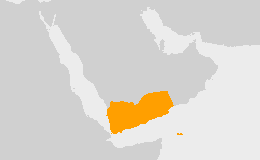
Yemen - 2012
Capital: Sana'a

29 Forced Labour (1930) 87 Freedom of Association and Protection of the Right to Organise (1948) 98 Right to Organise and Collective Bargaining (1949) 100 Equal Remuneration for Work of Equal Value (1951) 105 Abolition of Forced Labour (1957) 111 Discrimination in Employment and Occupation (1958) 138 Minimum Age for Employment (1973) 182 Worst Forms of Child Labour Convention (1999)
reported violations - 2012
Background
Yemen is the poorest country in the Middle East. Yemenis reportedly work for daily wages with little or no job security – one in ten of the workforce is a child. At the start of 2011, 40 per cent of Yemenis were living on less than USD2 a day. Unemployment was estimated to be more than 35 per cent.
Anti-government protests: The lack of jobs, poverty and corruption initially drove many Yemenis to join in the wave of protests sweeping the Arab world in 2011. Several thousands of Yemenis held numerous protests in the capital Sanaa and elsewhere throughout 2011, calling for the president and his allies to step down.
Hundreds of protestors have reportedly been killed during the uprisings and many others were beaten and detained. Between 16-25 February, security forces allegedly killed at least nine people and injured more than 150 in the port city of Aden. Dozens of peaceful protesters and activists were detained. Some were released, but in at least eight cases detained activists “disappeared”. At least 30 people were killed and hundreds wounded on 18 March after security forces opened fire on protesters in Sanaa.
Protests were complicated by inter tribal conflict and fighting between security officials and militia from tribal leaders, including that of Sheikh Sadiq Al Ahmaraimed at ending the governments regime. Several bomb attacks and street fighting ended with civilian causalities.
In November 2011, after a series of protests and violent reprisals killing several hundred people, President Saleh finally agreed to cede power to his deputy in February 2012 in a deal rejected by most of the protestors due to his continued immunity from prosecution. Saleh had ruled since 1978, when he became president of the Yemen Arab Republic following a military coup.
The uprising and political conflict that followed have pushed Yemen to the edge of a severe humanitarian crisis in Yemen with mass shortages of food, water, electricity, fuel and other essential goods. Construction work dried up, leaving many of the estimated one million day labourers in dire poverty due to the lack of work and no social security. These workers had been employed on a daily basis without a written contract or legal protection. Many companies and factories closed down during the year, leaving tens of thousands more workers on the street and increasingly unable to meet their most basic needs. Many of the unemployed have joined demonstrations calling for change.
29 Forced Labour (1930) 87 Freedom of Association and Protection of the Right to Organise (1948) 98 Right to Organise and Collective Bargaining (1949) 100 Equal Remuneration for Work of Equal Value (1951) 105 Abolition of Forced Labour (1957) 111 Discrimination in Employment and Occupation (1958) 138 Minimum Age for Employment (1973) 182 Worst Forms of Child Labour Convention (1999)
Capital: Sana'a

reported violations- 2012
Trade union rights in law
Many excessive restrictions apply despite some trade union rights being recognised. While freedom of association
freedom of association
The right to form and join the trade union of one’s choosing as well as the right of unions to operate freely and carry out their activities without undue interference.
See Guide to the ITUC international trade union rights framework
is guaranteed in the Constitution, all unions must belong to the General Federation of Worker’s Trade Unions of Yemen (GFWTUY), the country’s only umbrella union organisation. A proposed Labour Code would allow foreign workers to join trade unions, although they would still not have the right to be elected to trade union office.
While the right to collective bargaining
collective bargaining
The process of negotiating mutually acceptable terms and conditions of employment as well as regulating industrial relations between one or more workers’ representatives, trade unions, or trade union centres on the one hand and an employer, a group of employers or one or more employers’ organisations on the other.
See collective bargaining agreement
is secured, the Ministry of Labour has the power to veto any collective bargaining
collective bargaining
The process of negotiating mutually acceptable terms and conditions of employment as well as regulating industrial relations between one or more workers’ representatives, trade unions, or trade union centres on the one hand and an employer, a group of employers or one or more employers’ organisations on the other.
See collective bargaining agreement
agreement. Agreements that are “likely to cause a breach of security or to damage the economic interests of the country” can be annulled.
Furthermore, the right to strike
strike
The most common form of industrial action, a strike is a concerted stoppage of work by employees for a limited period of time. Can assume a wide variety of forms.
See general strike, intermittent strike, rotating strike, sit-down strike, sympathy strike, wildcat strike
is very limited. Permission to strike
strike
The most common form of industrial action, a strike is a concerted stoppage of work by employees for a limited period of time. Can assume a wide variety of forms.
See general strike, intermittent strike, rotating strike, sit-down strike, sympathy strike, wildcat strike
must be obtained from the GFWTUY, and all strikes must concern more than two thirds of the workforce of the employer. Three weeks’ notice must always be given, and strikes may not be carried out for “political purposes”. Also, industrial disputes may be referred to compulsory arbitration
arbitration
A means of resolving disputes outside the courts through the involvement of a neutral third party, which can either be a single arbitrator or an arbitration board. In non-binding arbitration, the disputing parties are free to reject the third party’s recommendation, whilst in binding arbitration they are bound by its decision. Compulsory arbitration denotes the process where arbitration is not voluntarily entered into by the parties, but is prescribed by law or decided by the authorities.
See conciliation, mediation
at the request of only one of the parties, in which case a strike
strike
The most common form of industrial action, a strike is a concerted stoppage of work by employees for a limited period of time. Can assume a wide variety of forms.
See general strike, intermittent strike, rotating strike, sit-down strike, sympathy strike, wildcat strike
can be suspended for 85 days, and all strikes are banned in some sectors such as ports, airlines and hospitals.
Freedom of association / Right to organize
Principles
Freedom of association :
- >The right to freedom of association is enshrined in the Constitution.
- >The right to freedom of association is recognized by law but strictly regulated.
The proposed Labour Code had still not passed into law by the end of 2009.
Anti-Union discrimination:
- >The law does not specifically protect workers from anti-union discrimination.
Restrictions
Restrictions on workers' right to form and join organizations of their own choosing:
- >Single trade union system imposed by law and/or a system banning or limiting organising at a certain level (enterprise, industry and/or sector, regional and/or territorial, national)
- All unions must belong to the General Federation of Worker's Trade Unions of Yemen, the country's only umbrella union organisation.
Categories of workers prohibited or limited from forming or joining a union, or from holding a union office:
- >Other civil servants and public employees
- >Non-national or migrant workers
- The draft Labour Code would allow foreign workers to join trade unions, but they would still not have the right to be elected to trade union office.
- >Domestic workers
- >Others categories
- Minors aged between 16 and 18 can only join a trade union if their legal guardian agrees.
Right to collective bargaining
Principles
Right to collective bargaining:
- >The right to collective bargaining is recognised by law but strictly regulated.
Restrictions
Restrictions on the principle of free and voluntary bargaining:
- >Authorities' approval of freely concluded collective agreements
- The Ministry of Labour has the power of veto over any collective bargaining agreement. Agreements that are "likely to cause a breach of security or to damage the economic interests of the country" can be annulled.
Right to strike
Principles
Right to strike:
- >The right to strike is recognised by law but strictly regulated.
Restrictions
Barriers to lawful strike actions:
- >Previous authorisation or approval by authorities required to hold a lawful strike
- Permission to strike must be obtained from the General Federation of Worker's Trade Unions of Yemen.
- >Excessive representativity or minimum number of members required to hold a lawful strike
- A strike call must concern more than two thirds of the workforce of the employer.
- >Obligation to observe an excessive quorum or to obtain an excessive majority in a ballot to call a strike
- The proposal to strike must be put to at least 60% of all workers concerned, of whom 25% must vote in favour.
- >Excessively long prior notice / cooling-off period
- Three weeks’ notice must be given.
Ban or limitations on certain types of strike actions:
- >Restrictions with respect to the objective of a strike (e.g. industrial disputes, economic and social issues, political, sympathy and solidarity reasons)
- Strikes may not be carried out for "political purposes".
Undue interference by authorities or employers during the course of a strike:
- >Authorities' or employers' power to prevent or end a strike by referring the dispute to arbitration
- Disputes may be referred to compulsory arbitration at the request of only one of the parties, in which case a strike can be suspended for 85 days.
Limitations or ban on strikes in certain sectors:
- >Discretionary determination or excessively long list of "essential services" in which the right to strike is prohibited or severely restricted
- Strikes are banned in some sectors, such as ports, airlines and hospitals.
29 Forced Labour (1930) 87 Freedom of Association and Protection of the Right to Organise (1948) 98 Right to Organise and Collective Bargaining (1949) 100 Equal Remuneration for Work of Equal Value (1951) 105 Abolition of Forced Labour (1957) 111 Discrimination in Employment and Occupation (1958) 138 Minimum Age for Employment (1973) 182 Worst Forms of Child Labour Convention (1999)
Capital: Sana'a

reported violations - 2012
In practice
A general strike
strike
The most common form of industrial action, a strike is a concerted stoppage of work by employees for a limited period of time. Can assume a wide variety of forms.
See general strike, intermittent strike, rotating strike, sit-down strike, sympathy strike, wildcat strike
shut most shops and offices on 7 April despite threats of reprisals against strikers and protestors. In November, President Ali Abdullah Saleh finally signed an agreement to transfer power. However, protestors called strikes to demonstrate against his proposed immunity from prosecution, for the removal of his relatives and associates suspected of corruption from their government or military posts.
This wave of strikes began in the third week of December with a walk out at the national airline, followed by strikes at the state television and Sanaa police headquarters, and a strike
strike
The most common form of industrial action, a strike is a concerted stoppage of work by employees for a limited period of time. Can assume a wide variety of forms.
See general strike, intermittent strike, rotating strike, sit-down strike, sympathy strike, wildcat strike
by hundreds of government soldiers. Industrial action
industrial action
Any form of action taken by a group of workers, a union or an employer during an industrial dispute to gain concessions from the other party, e.g. a strike, go-slow or an overtime ban, or a lockout on the part of the employer.
spread throughout the country on 28 December.
29 Forced Labour (1930) 87 Freedom of Association and Protection of the Right to Organise (1948) 98 Right to Organise and Collective Bargaining (1949) 100 Equal Remuneration for Work of Equal Value (1951) 105 Abolition of Forced Labour (1957) 111 Discrimination in Employment and Occupation (1958) 138 Minimum Age for Employment (1973) 182 Worst Forms of Child Labour Convention (1999)
Capital: Sana'a

reported violations - 2012
Violations
Teachers throughout Yemen went on strike
strike
The most common form of industrial action, a strike is a concerted stoppage of work by employees for a limited period of time. Can assume a wide variety of forms.
See general strike, intermittent strike, rotating strike, sit-down strike, sympathy strike, wildcat strike
during April, demanding salary increases previously agreed with the government be honoured. It was reported that striking teachers were replaced with volunteers and absent teachers were dismissed. The government told private schools that they would lose their licence if their teachers continued to strike
strike
The most common form of industrial action, a strike is a concerted stoppage of work by employees for a limited period of time. Can assume a wide variety of forms.
See general strike, intermittent strike, rotating strike, sit-down strike, sympathy strike, wildcat strike
. One source reported beatings and threats to striking teachers. The teachers have little legal protection as the civil service law states that if a teacher is absent for 20 consecutive days he or she will be dismissed.
The Yemeni Teachers Syndicate (YTS) and its members have been particularly exposed by the repression as they have been active since the beginning of the uprising in February. At least 40 YTS members were killed during the protests in 2011.
Widespread violence is directed against journalists. Reports of abductions, kidnappings, arbitrary arrests, beatings and torture are commonplace. During February, security forces beat or harassed at least 31 international and Yemeni journalists in an effort to quash reporting on the nationwide protests. On 25 October, gunmen shot two television journalists, killing one and injuring the other. This came weeks after the deputy director of a local radio station died of gunshot wounds from an attack on 25 September believed to have been carried out by Yemeni security forces.
On 12 March, the offices of the Yemeni Journalists’ Syndicate were attacked and arson threatened. The International Federation of Journalists (IFJ) reported a concerted campaign to intimidate and silence journalists which included detention and the burning down of a senior editor’s house following deaths threats against him and his family.
The Yemen state television authority warned in June that media workers who defied state orders to censor reporting on the anti-government protests would be sacked.
See general strike, intermittent strike, rotating strike, sit-down strike, sympathy strike, wildcat strike on 7 March demanding improvements in their pay. At least 3 were injured during the dispersal of their sit-in by police in Sanaa.
See general strike, intermittent strike, rotating strike, sit-down strike, sympathy strike, wildcat strike on 4 May. An agreement was reached later that day to suspend the strike strike The most common form of industrial action, a strike is a concerted stoppage of work by employees for a limited period of time. Can assume a wide variety of forms.
See general strike, intermittent strike, rotating strike, sit-down strike, sympathy strike, wildcat strike during negotiations. However, four months later union leaders said demands from the strike strike The most common form of industrial action, a strike is a concerted stoppage of work by employees for a limited period of time. Can assume a wide variety of forms.
See general strike, intermittent strike, rotating strike, sit-down strike, sympathy strike, wildcat strike had yet to be met.
29 Forced Labour (1930) 87 Freedom of Association and Protection of the Right to Organise (1948) 98 Right to Organise and Collective Bargaining (1949) 100 Equal Remuneration for Work of Equal Value (1951) 105 Abolition of Forced Labour (1957) 111 Discrimination in Employment and Occupation (1958) 138 Minimum Age for Employment (1973) 182 Worst Forms of Child Labour Convention (1999)
Capital: Sana'a
